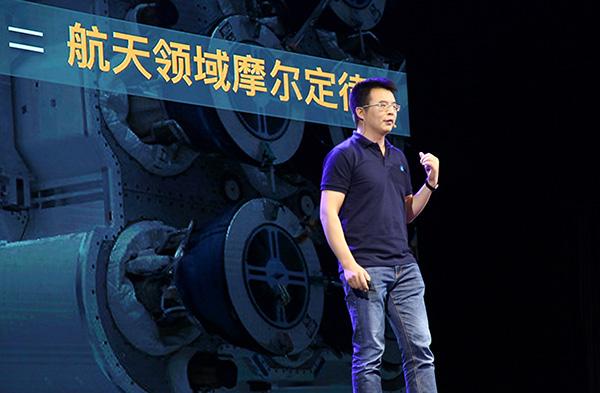
The "Artificial Intelligence Ethics, Governance And Sustainable Development Forum" Was Held Online, With More Than 5,000 Participants.

The "Artificial Intelligence Ethics, Governance And Sustainable Development Forum" Was Held Online, With More Than 5,000 Participants.
The Deputy Secretary-General of the United Nations was invited to give a keynote speech
[Abstract] Recently, the "Artificial Intelligence Ethics, Governance and Sustainable Development Forum" was successfully held. The Deputy Secretary-General of the United Nations was invited to give a keynote report at the conference. Xu Qiang, Director of the Beijing Municipal Science and Technology Commission, attended and delivered a speech. More than 5,000 experts and scholars attended the conference online. The forum released the "Artificial Intelligence Think Tank for Sustainable Development" and the "Artificial Intelligence Public Welfare Research Plan for Sustainable Development".
On June 22, the "Artificial Intelligence Ethics, Governance and Sustainable Development Forum" hosted by the Zhiyuan Artificial Intelligence Ethics and Sustainable Development Center and co-organized by the Sino-British Artificial Intelligence Ethics and Governance Center of the Institute of Automation, Chinese Academy of Sciences and the Megvii Artificial Intelligence Governance Research Institute was successfully held. The Deputy Secretary-General of the United Nations was invited to give a keynote report at the conference. Xu Qiang, Director of the Beijing Municipal Science and Technology Commission, attended and delivered a speech. About 5,300 experts and scholars from around the world participated in the conference online.
The Deputy Secretary-General of the United Nations introduced the "United Nations Digital Cooperation Roadmap" released on June 11. The primary goal of the roadmap is to "connect, respect and protect people in the digital age", to achieve a sustainable and inclusive recovery amid the global COVID-19 pandemic, and to promote global digital cooperation to deal with problems such as serious abuse of technology around the world. Its main contents include promoting digital universal connectivity, promoting digital technology to become a public good, ensuring that digital technology benefits everyone, supporting digital capacity building, and establishing digital trust and security.
Xu Qiang, director of the Beijing Municipal Science and Technology Commission, pointed out in his speech that Beijing issued the "Beijing Consensus on Artificial Intelligence" in May 2019, providing a "Beijing Plan" for standardizing and leading the healthy development of artificial intelligence. Zhiyuan Research Institute takes the lead in building a comprehensive sandbox platform for artificial intelligence risk and security, which plays an important role in realizing "self-discipline", "good governance" and "orderliness" of artificial intelligence. It is hoped that universities, institutions, enterprises, etc. in the field of artificial intelligence in Beijing will fulfill their social responsibilities, develop "artificial intelligence for sustainable development", promote the sustainable development of global society, economy and environment, and promote the construction and realization of a community with a shared future for mankind.
Witnessed by Xu Qiang, deputy secretary-general of the United Nations and director of the Municipal Science and Technology Commission, Professor Xue Lan of Tsinghua University, co-chairman of the Sustainable Development Network Leadership Committee, and Dr. Kaifu Li, CEO of Sinovation Ventures, Zeng Yi, director of the Zhiyuan AI Ethics and Sustainable Development Research Center and researcher at the Institute of Automation, released the "Artificial Intelligence Think Tank for Sustainable Development" and the "Artificial Intelligence for Sustainable Development Public Welfare Research Plan" on behalf of Zhiyuan and relevant partners.
The meeting invited Danit Gal, technical advisor to the United Nations and part-time researcher at the Intelligent Futures Research Center of the University of Cambridge, S Gill, former executive director of the United Nations Secretary-General's High-Level Panel on Digital Cooperation, Professor Lütge, director of the AI Ethics Center of the Technical University of Munich, leader of the World Health Organization (WHO) Expert Group on AI Ethics and Governance in the Health Field, Professor Effy of the Swiss Federal Institute of Technology in Zurich, PhD, head of AI ethics at the Alan Turing Institute, and member of the UNESCO (UNESCO) Special Expert Group on Artificial Intelligence Ethics, IEEE Co-chairman of the Robot Ethics Committee of the Society of Robotics and Automation and professor of Eindhoven University of Technology gave a special report at the conference.

"Linking East and West AI Ethics, Governance and Sustainable Development" Roundtable Discussion
The meeting also held a roundtable discussion on "Linking East and West AI Ethics, Governance and Sustainable Development". Dr. Seán Ó hÉ, Research Director of the Future Intelligence Research Center of the University of Cambridge, Professor Liu Qiao, Dean of the Guanghua School of Management at Peking University, Xu Yuncheng, Director of the Megvii Artificial Intelligence Governance Research Institute, and Dr. Wu Guobin, Director of Technology Ecology and Development of Didi Chuxing, were invited to participate in the roundtable discussion and interact with online participants. Forum guests generally felt that global cooperation in artificial intelligence ethics and governance faced challenges, and urged the need to strengthen exchanges and innovative cooperation; the world has initially established a system of artificial intelligence ethics and governance principles, and it is necessary to focus on implementation and application practice; the guests unanimously recognized that artificial intelligence plays a huge role in the process of global sustainable development, but they must pay attention to the potential risks involved, and carry out developing artificial intelligence ethics and governance work, so as to promote the realization of global sustainable development goals through artificial intelligence.
Summary of forum guest discussion opinions
1. Global cooperation on ethics and governance of artificial intelligence faces challenges, and it is necessary to strengthen exchanges and innovative cooperation. Strengthening the ethics and governance of artificial intelligence has become a global consensus, and many countries have issued policies and guidance related to ethics and governance of artificial intelligence. However, exchanges between the East and the West and between countries are affected by different cultures and national conditions and can easily lead to misunderstandings, competition, and cooperation. Seán óhé, director of the Future Intelligence Research Center at the University of Cambridge, pointed out that language expressions under cultural differences can easily lead to unnecessary misunderstandings and deepen the gap. United Nations technical advisor Danit Gal believes that insufficient communication leads to misunderstandings and competition. He recommends strengthening communication, promoting cooperation, advocating and stimulating global cooperation and international collaborative innovation on a global scale. Xu Yuncheng, director of the Megvii Artificial Intelligence Governance Research Institute, suggested that countries use transparency to gain trust and promote cooperation through the common goal of sustainable development. Liu Qiao, dean of Peking University Guanghua School of Management, suggested that an effective mechanism should be established to promote discussions and form a consensus among stakeholders.
2. The world has initially established a system of artificial intelligence ethics and governance principles, and it is necessary to focus on application practice and pilot work. At present, different intergovernmental organizations, national and regional governments, scientific research institutions, and enterprises around the world have proposed artificial intelligence (ethics) principles or related proposals at different levels. Although the principles of each company have different emphasis in expression, they are relatively consistent in some core contents, and a relevant principle framework system has been initially formed. However, due to the opacity of artificial intelligence technology, inconsistent evaluation standards in different regions, and unclear regulatory agencies, the formulation and practice of artificial intelligence principles in specific application fields are not close enough. Effy Vayena, a professor at the Swiss Federal Institute of Technology in Zurich and leader of the World Health Organization (WHO) expert group on AI ethics and governance in the field of health, suggested that experts should be promoted to guide companies to conduct pilot demonstrations of AI development and ethical governance, and explore the establishment of data utilization and protection mechanisms for artificial intelligence technology in sensitive fields such as medical and health care.
3. Artificial intelligence plays a huge role in achieving sustainable development around the world, but attention must be paid to the ethics and governance of artificial intelligence. Artificial intelligence technology has played a role in poverty alleviation, environmental protection, medical health, equality and justice, social governance and security and other sustainable development aspects. However, artificial intelligence that is not ethical and safe may harm society and harm human beings. Lütge, director of the AI Ethics Center at the Technical University of Munich and founder of the Global AI Ethics Association, suggested that in the process of promoting artificial intelligence to empower social development, attention should be paid to the construction of artificial intelligence ethics, and artificial intelligence supervision and governance should be strengthened on issues such as equality, justice, privacy, and discrimination. The person in charge of AI ethics at the Alan Turing Institute and a member of the UNESCO Special Expert Group on Artificial Intelligence Ethics suggested that when artificial intelligence faces different races, genders and other groups, different prediction models need to be used to solve potential discrimination, unfairness and other ethical issues.
4. Scientific artificial intelligence ethics and governance promote the sustainable development of high-level artificial intelligence and promote the realization of global sustainable development goals. The purpose of ethics and governance is to solve ethical issues such as fairness, equality, privacy, and discrimination, which promotes the development of artificial intelligence in a direction that is understandable, safe, transparent, effective, and responsible, and becomes an important guarantee for promoting the realization of global sustainable development goals. Related work has improved the accuracy and effectiveness of artificial intelligence while solving issues such as equality and discrimination. Professor at Eindhoven University of Technology and co-chairman of the Robot Ethics Committee of the IEEE Robotics and Automation Society believes that the development of artificial intelligence ethics promotes the advancement of artificial intelligence technology. Professor Liu Qiao believes that artificial intelligence governance promotes artificial intelligence to improve its ability to respond to accidents. Xu Yuncheng believes that sustainable social development requires sustainable artificial intelligence technology, and technological sustainability is the strategic goal of enterprise development.
Wisdom reveals the future and provides insight into new knowledge