The World Internet Conference Spent Half A Day Discussing "Artificial Intelligence Ethics"

The World Internet Conference Spent Half A Day Discussing "Artificial Intelligence Ethics"
On the afternoon of November 10, the Artificial Intelligence and Digital Ethics sub-forum of the World Internet Conference was held. In the dense sub-forum agenda of the World Internet Conference, up to 12 sub-forums are held simultaneously, and only this "exclusive" half-day session is held.
Zhang Bo, Honorary Dean of the Institute of Artificial Intelligence of Tsinghua University and Academician of the Chinese Academy of Sciences: Clarifying ethical standards requires global cooperation
"When machines continue to advance and develop, and one day their intelligence exceeds that of humans, especially when they have subjective consciousness, humans will lose control of the machines, bringing catastrophic consequences." - The risk of artificial intelligence has long been raised, and Hawking also issued a warning, but we once thought it was far-sightedness.
By the beginning of this century, when deep learning based on big data emerged in artificial intelligence, people's understanding had changed. They felt that the ethical risks of artificial intelligence were right in front of them, and governance was imminent.
According to the current artificial intelligence technology, we can use deep neural networks to generate text and images that meet the requirements and are of good quality according to the user's requirements. Similarly, we can also violate the requirements and generate text and images that are full of racial, gender and other biases, unfair and error-free, and are not controlled by the user. If decisions and predictions are made based on these erroneous texts, serious consequences may occur.
If you want the machine to develop towards intelligence, you cannot let the machine be completely at the mercy of humans. You need to give it a certain degree of freedom and autonomy. Deep neural networks are based on this principle: using probability as a data tool, the machine can generate rich text and images. But also for this reason, there must be a probability of generating substandard and harmful text and images.
The development of artificial intelligence will inevitably bring about an impact on ethics and traditional norms. Fundamentally speaking, the research and development of artificial intelligence must be people-oriented and proceed from the ethical principles of justice and fairness. To this end, we need to work hard to establish explainable and robust artificial intelligence theory. On this basis, it is possible to develop safe, trustworthy, controllable, reliable and scalable artificial intelligence technology.
The research and governance of artificial intelligence require the cooperation of people from different fields around the world. In addition to those engaged in the development and use of artificial intelligence, legal, moral, ethical and other personnel are also required to participate. Ethical and moral standards need to be clarified, which requires global cooperation to jointly formulate standards that are in the interest of all mankind.
Zhu Shiqiang, Director of Zhijiang Laboratory and Vice Chairman of China Artificial Intelligence Industry Alliance
Zhu Shiqiang, Director of Zhijiang Laboratory and Vice Chairman of China Artificial Intelligence Industry Alliance: Build a technical map to prevent potential harm and control evil with the right
Artificial intelligence technology brings convenience to production and life, but it also brings negative things, causing thoughts and even excessive worries about the ethics of artificial intelligence.
The reality is that artificial intelligence is still weak artificial intelligence. It has higher individual abilities than humans in some individual fields, such as Go and protein sequencing, but its overall intelligence is still very weak. From a technical perspective, intelligence is relatively easy to obtain, but it is difficult to use machines to reproduce intelligence.
My point of view is that artificial intelligence is an extension of human intelligence in the field of machines. The real initiative still lies with people. The most important thing at this stage is still to develop technology, but at the same time, we must prevent the ethical problems caused to human beings by the technology itself and its abuse.
Zhijiang Lab has sorted out the AI ethics map and classified it from three aspects (research and development subjects, users, and management subjects). We are also building a technical map to prevent artificial intelligence from harming society, and trying to use technology to prevent the abuse and malicious application of artificial intelligence. Our logic is that kitchen knives are used to cut vegetables. Although kitchen knives have been used to kill people many times, they have no original sin. Our logic is to "control demons with Tao" and use technical means to make kitchen knives sharp, but so that they can never cut people.
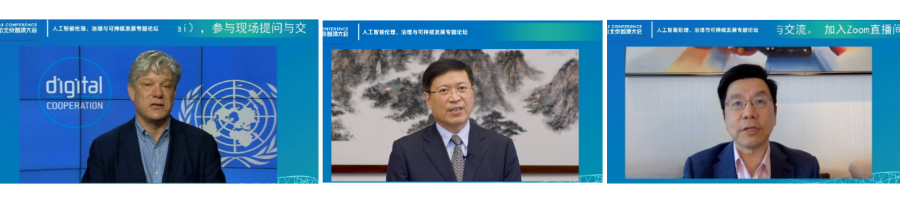
Yang Debin, member of the Digital Economy Development Committee of the Hong Kong SAR Government, delivered a video speech
Yang Debin, member of the Digital Economy Development Committee of the Hong Kong SAR Government: Human beings should improve themselves and avoid gradual "degradation"
The computing power of computers is getting stronger and stronger, and they can do more and more things for humans. Many jobs that were previously done by humans are gradually being replaced by machines due to their repetitiveness, danger, and cost issues, such as the "black light factory" in intelligent manufacturing, drones replacing people to detect sewers, and robots replacing security patrols.
Machine learning triggered by big data has flourished in various industries in recent years. In 2016, a robot defeated the ninth-level Go player Lee Sedol and the world's number one Ke Jie. In recent years, machine learning has made considerable progress in autonomous driving, medical diagnosis, and even writing, painting, and poetry. Still, artificial intelligence is far from human intelligence.
Artificial intelligence and human intelligence can be compared to a tortoise and a hare race, with humans being the hare and machines being the tortoise. As humans become more and more dependent on machines and machines can do more and more, things will gradually change. When humans leave things to machines, will we become lazy or even stupid? In the past, we would remember the phone numbers of several family members and friends we often contacted. Now, as long as the mobile phone voice dials automatically, there is no need to remember. Over time, memory will deteriorate.
What I am more worried about is not that machine learning will one day surpass humans, but that humans will become unintelligent due to over-reliance on machines. The tortoise and the hare is a fable that tells us that we cannot lose to our opponents because of complacency. We can teach machines to be smarter, and we can properly constrain machines so that they do not harm humans, but humans should improve themselves to avoid gradual degradation.
Joseph Sifakis, winner of the 2007 Turing Award and member of the Association of Top Scientists in the World, delivered a video speech
Joseph Spakis, winner of the Turing Award in 2007 and a member of the Association of Top Scientists in the World: Choices and Balances between Artificial Intelligence and Ethics
Let me start by saying that advances in artificial intelligence are turning automated systems into autonomous systems, which reflects the trend from weak artificial intelligence to general artificial intelligence.
Normal ethics is about making the right decisions. In order to make the right decision, you should first have a sense of choice. Now many people are confused by different opinions on how to use artificial intelligence reasonably. I think society must create conditions for calm, informed and reasonable debate. We should strike a balance between strictly implementing the risk prevention principle and accepting innovation to improve efficiency or quality. When we download a system now, we will face the dilemma between choice risk and performance.
Another important dilemma is how to divide labor between humans and machines. Innovation and technological progress may mean the loss of skills. It is difficult to imagine that machines can surpass human intelligence. However, if we are greedy for laziness and comfort, human intelligence can also be tamed and conquered. It would be very bad for humanity if we were defeated by the complexity of machines.
Jiang Bixin, deputy chairman of the Constitution and Law Committee of the National People's Congress
Jiang Bixin, Deputy Chairman of the Constitution and Law Committee of the National People's Congress: "Five Sources" and "Six Completes" of the Construction of Artificial Intelligence Ethics
Why should we construct artificial intelligence ethics and digital ethics? It can be simply summarized as "five causes": from the duality of digital technology and artificial intelligence, which brings both benefits and risks; from the borderless, transnational, professional, and non-transparent nature of digital networks; from the limitations of legal norms; from the indispensability of moral ethics to human beings; from the dependence of the development of network security on human morality.
I believe that the basic rules of this ethical system are to seek goodness, truth, and beauty, which is also the consensus of mankind. Specific rules are formed according to different periods, themes, environments, and fields—the current preliminary stage of artificial intelligence and the possible super-powerful stage in the future. The specific rules are changing.
How to turn rules from concept into reality, and what mechanism should be established to turn it into reality? I summarize it as "six completes": all concepts, all subjects, all chains, all elements, all cycles, and all tools.
Gao Shiming, President of China Academy of Art
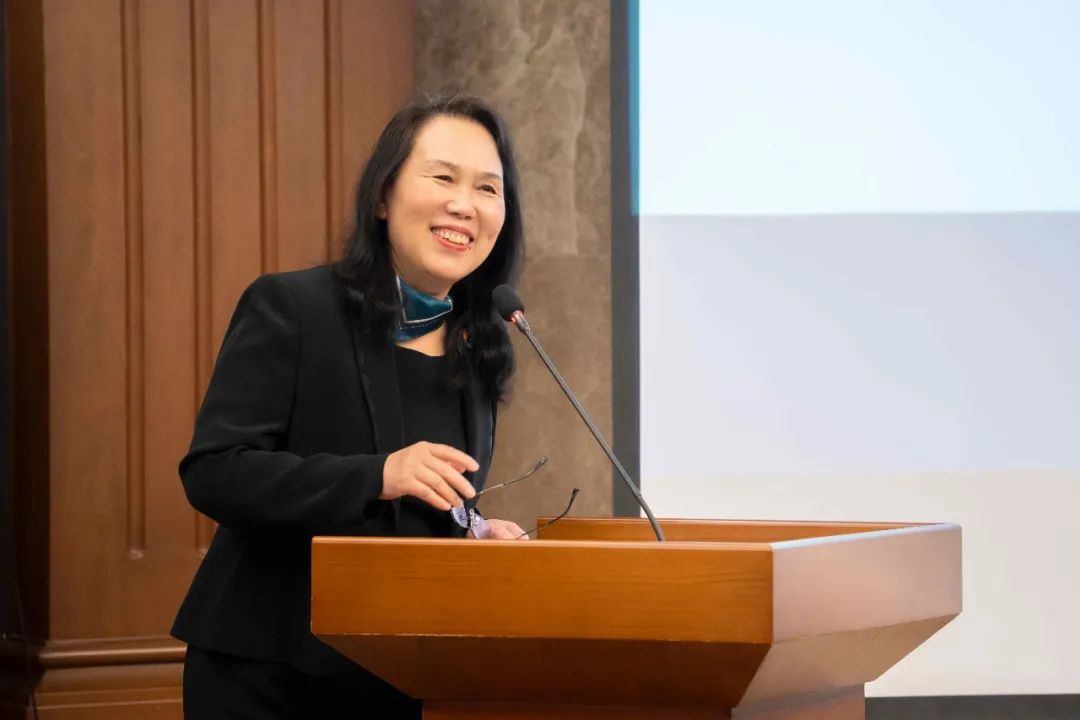
Gao Shiming, President of the China Academy of Art: Artificial intelligence can write poems and draw paintings, but it does not have the impulse and passion to do these things, while humans do
The significance of artificial intelligence to us is not only to simulate and extend human thinking, but more importantly, the development of AI technology has greatly promoted our understanding of human language, thinking, and intelligence itself, and helps to explore the intellectual processes of human thinking, learning, analysis, reasoning, planning, and imagination.
AI is not only a tool for research and manufacturing, but also a tool for perception and thinking. It is a mirror of human self-understanding and a mirror of human social consciousness. It is not even just a tool, but a partner. AI is part of us and part of our future.
Desire and willingness are perhaps the biggest differences between us and artificial intelligence. Artificial intelligence can write poetry, draw pictures, compose music, and beat humans on the chessboard, but it must accept instructions to write poetry, play chess, paint, and compose music. It does not have the impulse, desire, and will to do these actions, while humans not only have desires, but also passions.
How to use algorithms to deal with the complex, irrational and accidental interactions among countless social individuals is the difficulty of AI technology. The mind has no equations, and the social mind cannot be solved by algorithms.
There are many concerns about artificial intelligence. One of them is that artificial intelligence is gradually replacing and replacing our sensibility through calculation and simulation. AI's unlimited computing power also puts pressure and impetus on human imagination. I believe that the development of artificial intelligence is not to replace people. It in turn forces us to re-understand what creation is. Creation is the most meaningful production. Creation also involves curiosity, impulse, sensibility, care, desire, value, purpose, and most importantly, love for the unknown and nameless. As long as we still have these, we can boldly declare that those who can be replaced by artificial intelligence will let it go.