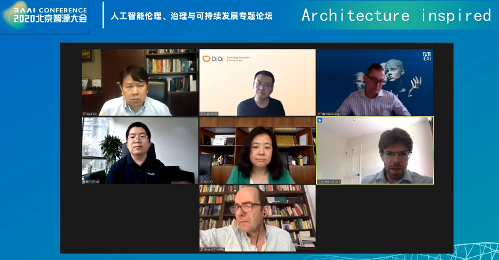
Song Bing: Global Artificial Intelligence Ethics Discussion And Reconstruction Of Basic Values

Song Bing: Global Artificial Intelligence Ethics Discussion And Reconstruction Of Basic Values
Conversation at POLITICO 2020 Artificial Intelligence Summit

The Artificial Intelligence Summit was held on September 30. Song Bing, deputy director of the Berggruen Institute and director of the China Center, was invited to have a conversation with Nicolas Miele ( ), co-founder and chairman of the Future Association, at the sub-forum "Cross Looks – AI, Lost in Translation" (Cross Looks – AI, Lost in?). They shared their views on the topic of "How different cultures understand the principles of artificial intelligence differently." In order to present the live conversation more clearly, we have condensed and excerpted the interview content. Please watch the video for details.
Q1
Is artificial intelligence a cultural concept?
Miele: The answer is of course yes. As a form of expression, artificial intelligence has profound socio-technological characteristics and dominates people's imagination, especially those related to society and technology. Different cultures will have different perspectives and risk appetites. Europeans are relatively more cautious, a bit technophobic to a certain extent, and more technological realism. However, China, the United States and some developing countries are more proactive in using technology and are more "obsessed" with new technologies. Therefore, from a definitional perspective, AI is obviously a cultural concept due to differences in regional development levels. In addition, artificial intelligence has natural cultural attributes. Because values do not arise out of thin air, they are rooted in culture.
Song Bing: Yes and no. When discussing culture, values are obviously a topic that cannot be avoided. I personally have summarized a "three-level framework" for analyzing values. The first level is basic values, the second level is mid-level values, and the third level is surface values.
Basic values refer to common values that are considered from the overall interests of human beings and other existences. At the base level we will see values such as interconnectedness, connectedness, relationality, interembeddedness and symbiosis. At this level, differences between cultures lose meaning and become less important. These values are especially important in risks and challenges at the level of human survival, such as the values of human society during the COVID-19 epidemic.
Surface values are the result of the transformation and integration of value systems with the development of modernization and economic globalization. For example, the pursuit of prosperity, wealth, efficiency, convenience, and competition. At this level, cultural differences are also suppressed. This also explains why the world is seeking economic development regardless of culture and geographical region.
At mid-level values, culture becomes a key factor. For example, the way certain programs are applied, the general attitude of the public towards artificial intelligence and risk assessment, how different values are prioritized, how social development matches and balances the protection of individual rights, as well as different forms and governance cultures of political governance, etc. All of the above result in different cultures and societies having different understandings and applications of artificial intelligence.
From a methodological perspective, basic values focus on holistic and symbiotic thinking; while what occupies an important position at the intermediate and superficial levels is more binary thinking and zero-sum game. The values of these three levels are intertwined with each other. The current discussions around artificial intelligence and ethics around the world mainly focus on the values of the surface and middle levels. But can these principles and concepts really become the basic values that build the common premise of human beings and other existences? Frankly speaking, without the guidance of basic values, the quarrels between you and me on a global scale will last for a long time.
Q2
Is there a possibility of convergence between different regions of the world? Is it possible to develop public definitions and shared values?
Miele: Yes, it is possible, and we must strive for consensus. When I say "agree" I don't mean that we will agree on everything. There are different social systems, different socio-economic and cultural foundations, and different values. This is the beauty of diversity.
The key challenge in seeking common ground is how to reconcile “universality” with diversity, rather than trying to make everything the same. We need to illustrate what is local and diverse and what must be communal and global. If I were to give a description of a global common position, I think there are some similarities between different regions, and they have been reflected in many global common goals. Likewise, we can work hard to mediate and coordinate, and practice the values of freedom, interaction, and democracy while safeguarding the interests of all parties.
This process can be fraught with difficulties. In this scenario, Europe and the United States may be anxious about whether they can reach an agreement with China, and this anxiety may be used as an excuse to attack and exclude. We see that China wants to participate in dialogue and work together to achieve a common position. There is a lot of resistance in the United States and Europe, and they doubt whether China's original intention to reach a common position is sincere. Therefore, on the one hand, it is difficult to grasp the appropriate balance of cooperation and on the other hand, to clarify the boundaries.
But at least we should seek linguistic and conceptual consensus. Regarding concepts such as "weak artificial intelligence" and "strong artificial intelligence", even the Western scientific and engineering circles will hold different opinions, and there is a lot of consensus that needs to be reached. In my opinion, interaction with China is very beneficial.
Song Bing: Regarding the issue of "seeking common ground," I think countries around the world have found common ground in many aspects. There are now hundreds of "artificial intelligence principles", not only from the United States and European countries, but also from Asian countries such as China. I found that these principles basically revolve around five themes. One is technical related, such as security and explainability. The second is related to personal rights, such as privacy protection. The third aspect is related to publicity, such as sharing, cooperation, and dialogue. The fourth aspect is related to accountability, such as credibility and responsibility. There are also some broad principles, such as democracy, human rights, fairness and humanitarian spirit.
All in all, a general consensus has long been formed. The important question is, how is the general consensus interpreted and applied in different cultural contexts? As I just pointed out in my analysis of the values framework, it is the middle value level where most cultural differences emerge. In the current geopolitical environment, I am pessimistic about resolving differences because of the lack of trust between countries. When reading media reports about China, you will find that these reports often view China and the Chinese government with distrust from a Western perspective, and there are many misunderstandings and exaggerations. Similarly, in China, there is no trust in Western governments and Western media. In a sense, we live in two parallel worlds, in a very complex and chaotic media environment. So I wonder how we can move beyond this binary competitive mentality to a discussion about fundamental values. I think that everyone coming together to find out the issues that countries around the world should jointly deal with is the starting point for strengthening mutual understanding.
Here are two specific examples of what is available for discussion. Ideally, the United Nations, the European Union or other non-governmental organizations could organize some global projects that truly involve people from different cultural backgrounds. For example, facing a global epidemic is like facing natural disasters such as earthquakes and tsunamis. The United States, the European Union, China, and Russia can jointly respond, using artificial intelligence to establish warning mechanisms and find ways to deal with them. It may not be possible to eliminate geopolitics, but we can make more efforts on a global scale and move towards the common well-being of all mankind instead of hindering each other.
Another area that could be discussed is the weaponization of artificial intelligence. Countries are deeply affected by geopolitics and are unlikely to stop research on the weaponization of artificial intelligence, but these countries should discuss the bottom line issue together. For example, which civilian facilities and key infrastructure cannot be attacked when conflicts arise, regardless of cultural values and political leanings. There are some bottom lines that all parties need to abide by.
Miele: We see two complementary approaches emerging. One is a top-down global cooperation that discusses ontological and metaphysical factors such as values. I agree with you that this approach is not very effective due to strategic tensions. Because of the lack of trust, we will feel that the other party is instrumentalizing values to satisfy its own strategic interests.
However, I think that when a bottom-up approach is taken, the United States, Europe and China may have a common position on ensuring the safety of self-driving cars. We all agreed to establish an independent review and certification mechanism and to compete in the industry around these standards. As a global community, we need to find best practices for independent review and certification to reflect our shared values of security and accountability.
Regarding the ability of the above three regions to reach a consensus on best practices, as you said, we cannot be too optimistic. Because there is a lot of competition within the industry on certification and standards issues. At present, Europe has decided to use values as an advantage to gain competitiveness. This creates a tension between European countries believing that their AI is superior to other countries because it respects values, while at the same time trying to find a common position among different countries.
When I compare European artificial intelligence technology with the industrial production capacity of China and the United States, frankly speaking, Europe is indeed slightly inferior. We can continue to create the rules of the game without putting too much effort into mastering the mechanics of the game. But at the end of the day, the people who have the say are the ones who have the skills to play the game. Therefore, for Europe, we must promote the value of "trustworthy artificial intelligence" and have corresponding moral and political obligations to accelerate industrial development, master artificial intelligence technology capital, and improve industrial competitiveness. Europe will continue to help global consumers with regulations and policies, but also consider the interests of European workers. It is urgent to combine the long-term goals of values with the reality of a weak industry.
Q3
Dialogue with China is indeed important, why is China not part of the global partnership on artificial intelligence?
Song Bing: Generally speaking, the way Europe and the United States reach consensus is by first issuing a declaration, drafting a series of principles, collecting signatures, and getting everyone to believe and agree to these principles. Since the discussion of values can be used to achieve geopolitical purposes, people are mostly skeptical about it, especially in light of the current environment. I believe that if we want to propose globally shared values, we should involve all relevant parties from the beginning, rather than just asking them to sign off on something that has already been drafted.
Let’s talk about the issue you just mentioned before, which is that Europe wants to lead the discussion of values, but at the same time believes that its own value system is the best. Is there a tension between the two? I do see this issue. The EU's "White Paper on Artificial Intelligence" states that although we cannot yet predict future digital technologies, European values and ethical principles, social and environmental norms must apply. ——I think this statement is particularly strange. You don’t even know the trajectory of development, but you conclude that your values must be applicable, and you also mentioned that you will export these values to the world. I believe that if we want to achieve global consensus, we need to move away from arrogance and rigidity about values.
Miele: Regarding the issue of global AI partners, countries outside the G7 hope to form an “alliance” with “like-minded” countries to jointly envision visions and approaches, to responsibly grasp the power of AI and build the future society we want. This has been made very clear. China was not invited to form this alliance from the beginning. Whether this is a good or bad thing is another discussion. But I think like-minded countries can cooperate, which is why a global platform is needed to build bridges. For this reason, the Secretary-General of the United Nations established an Artificial Intelligence Advisory Group to try to build bridges between developing countries, including China, and the Group of Seven. He also established the Global Artificial Intelligence Partnership Project to promote credible artificial intelligence applications to enhance human welfare.

We live in a time of great change. By building a global dialogue platform, promoting cross-cultural exchanges, promoting academic and ideological innovation, and creating new governance policies, the Berggruen Institute is committed to enhancing mankind's in-depth understanding of this era of change, cultivating and developing new ideas and concepts, and helping global institutions, policymakers, and the public respond to the profound changes affecting mankind.